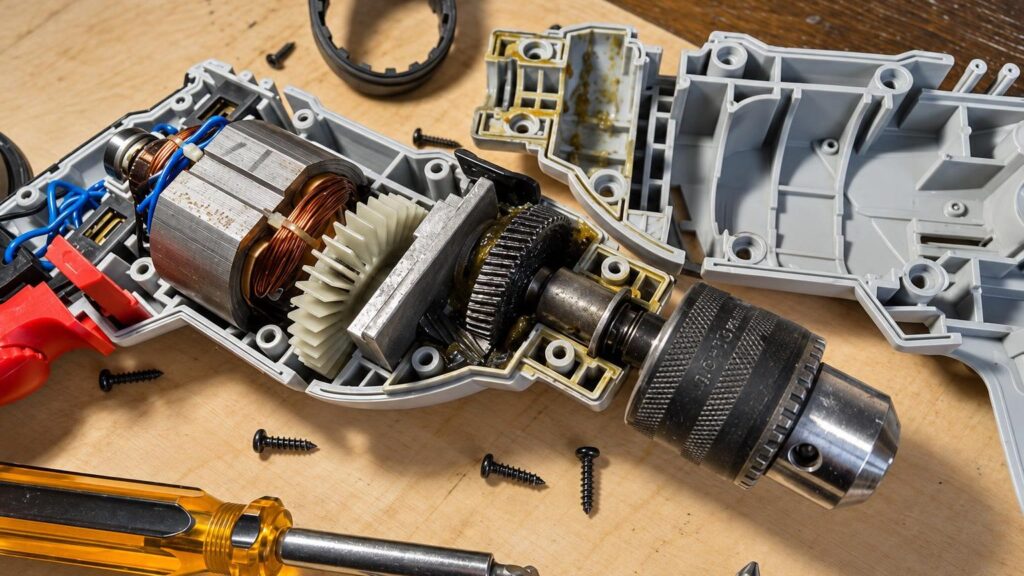
The symptom often lets you guess which part is worn. This is only a general guide – the exact cause can be determined only by diagnostics. In hammer drill fault statistics, about 40% of cases are those where the tool does not switch on at all.
01from 12 €
The hammer drill does not switch on
WhyMost often the culprit is a worn carbon brush, a faulty switch, or a damaged power cable at the plug or the cable entry. Less often, it is a burnt-out motor armature.
Check it yourselfCheck that the socket and extension cord work – plug in another appliance. Inspect the cable for cuts. Do not disassemble the tool.
What we doWe test the circuit, replace the carbon brushes, switch or cable, and if necessary, repair the motor part.
02from 12 €
The power tool is sparking
WhySlight sparking at the carbon brushes is sometimes normal, but strong flashing indicates worn brushes, a dirty commutator or a damaged armature. Read more in the article why a power tool sparks.
Check it yourselfStop using it if the sparks are bright or you notice a burning smell. Do not open the housing or clean the commutator yourself.
What we doWe replace the carbon brushes, clean and inspect the commutator, and measure the armature windings.
03from 15 €
Smoke is coming from the tool or there is a burning smell
WhyThe cause may be an overheated motor, a short circuit in the armature or field winding, a broken switch, or prolonged work under excessive load.
Check it yourselfUnplug it immediately and let the tool cool down. Do not switch it on again until a technician has inspected it.
What we doWe inspect the windings, switch and insulation, and replace damaged electrical parts.
04from 18 €
The hammer drill chuck slips
WhyMost often the chuck itself, its seals or the clamping mechanism wears out. Sometimes a worn or wrong-sized drill bit is to blame.
Check it yourselfTry another, undamaged drill bit and make sure it is fully inserted and locked.
What we doWe replace the chuck or its parts and inspect the spindle and the locking mechanism.
05from 15 €
Weak impact or the drill bit turns too slowly
WhyThe carbon brushes may be worn, the mode selector switch faulty, the grease dried out, or the impact mechanism worn.
Check it yourselfCheck that the mode switch is set to the correct position and that the extension cord is not too long or too thin.
What we doWe clean and lubricate the mechanics, and replace the carbon brushes, the switch or worn parts of the impact mechanism.
06from 30 €
The motor runs, but the chuck does not turn
WhyIn this case the fault is usually mechanical: crumbled gears, a damaged drive or gearbox, or a worn shaft.
What we doWe disassemble the gearbox, replace broken gears and bearings, and lubricate the mechanism.
07from 25 €
The tool vibrates heavily or squeaks
WhyVibration and friction noise are most often caused by worn bearings, damaged gears, a bent shaft or unevenly worn carbon brushes.
Check it yourselfCheck that the drill bit or disc is not bent and is properly tightened. If the vibration persists without an attachment fitted, the tool needs to be diagnosed.
What we doWe replace the bearings and gears, center the shaft and lubricate the mechanism.
08from 12 €
The angle grinder has stopped spinning or is jamming
WhyCommon causes are a stuck or worn switch, worn carbon brushes, a damaged cable, clogged ventilation openings, or a failed angle gear bearing.
Check it yourselfClean the dust off the external ventilation openings with a dry brush, only after unplugging the tool from the mains. Check the cable and plug.
What we doWe replace the carbon brushes, switch, bearings or angle gear, and check the motor.
09from 12 €
The cordless tool does not charge or discharges quickly
WhyThe cause may be a worn battery, a faulty charger, dirty contacts or the control board. For more details, see our articles on battery revival and battery care.
Check it yourselfTry the charger with another battery of the same type. Clean the external contacts with a dry cloth. Do not disassemble or heat the battery.
What we doWe diagnose the battery, charger and board, repair the charger or replace the battery cells.
10from 12 €
The cable, plug or socket is broken
WhyCables are most often damaged at the entry point due to constant bending, while sockets on chargers or cordless tools fail due to frequent plugging in and impacts.
Check it yourselfDo not use the tool with a loose, torn or heating cable.
What we doWe replace the cable, plug, socket or broken contacts.
11from 15 €
The multifunction, engraving or rotary tool does not work
WhyFaults in small tools are similar: a faulty switch, worn carbon brushes, a damaged cable or a control board with a speed controller.
Check it yourselfCheck that the power supply or charger is suitable and firmly connected.
What we doWe diagnose the electrical part, replace the switch or carbon brushes, or repair the board if the repair is technically feasible.