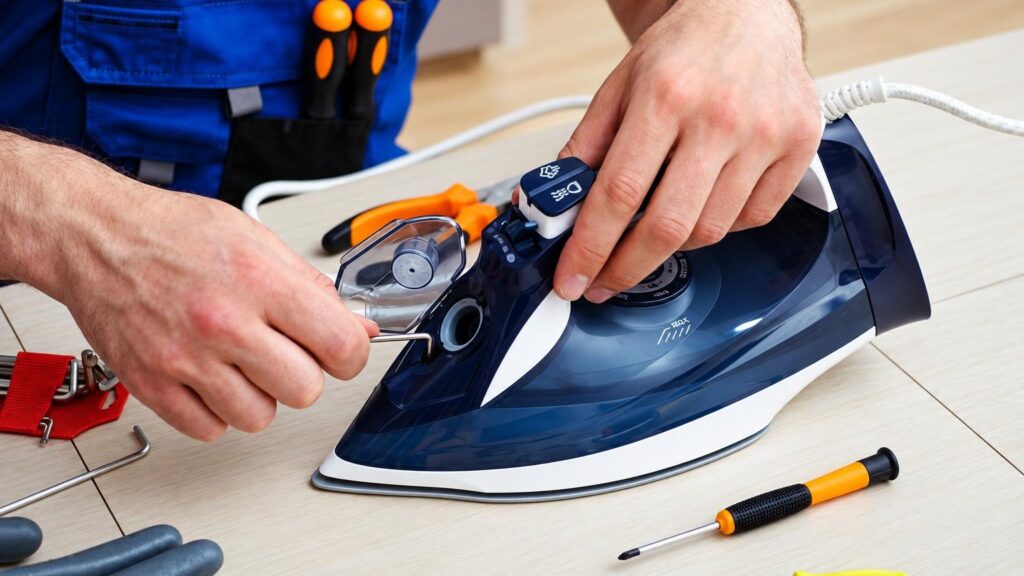
Below are the most common symptoms people bring their irons in with, and what you can safely check yourself. Do not open the mains-powered internal parts: inside the iron there is mains voltage and hot components.
01
The iron does not heat up
WhyMost often the thermostat or thermal fuse burns out, the cord breaks near the plug, or the heating element fails. Sometimes the cause is simply an unreliable power socket.
Check yourselfPlug the iron into a different socket, check that the cord and plug are not deformed or darkened, and that the temperature is not set to the lowest level. Do not use a damaged cord.
What we doWe check the heating circuit, determine which part is faulty and replace the thermostat, fuse or heating element.
02
The iron does not heat enough or overheats
WhyAn aged or misadjusted thermostat no longer switches off the heating on time, or switches it off too early. As a result the soleplate is either too cold and fabrics iron poorly, or too hot and scorches them.
Check yourselfCheck that the temperature control is set correctly and try a different setting. If the behavior is strange, do not use the iron any further.
What we doWe check the temperature control, replace the thermostat if necessary and verify that the soleplate heats evenly.
03
The iron does not switch on
WhyA broken internal wire, a faulty switch or power socket, or a tripped thermal fuse. Some models switch off by themselves if they are not moved for a while; this is not a fault.
Check yourselfTry a different power socket and check whether the iron has activated automatic shut-off: move it and wait a few seconds.
What we doWe check the power circuit and, if necessary, replace the switch, socket, cord or fuse.
04
The iron does not produce steam
WhySteam holes and channels become clogged with limescale, and sometimes the steam valve or pump fails. If tap water is used, limescale deposits build up within a few months.
Check yourselfCheck that there is water, that the temperature is set high enough and that the steam mode is on. Descale the iron only according to the manufacturer’s instructions, for example by using the cleaning function.
What we doWe remove limescale from the steam channels, check the valve and pump, and replace the faulty part.
05
The iron drips water
WhyDripping is most often caused by too low a temperature in steam mode, a worn water tank gasket or a limescale-clogged valve. Deposits can cause brown water to drip, which stains fabric.
Check yourselfIncrease the temperature in steam mode, do not fill the tank to the top, and wait until the iron has fully heated up before ironing.
What we doWe replace the gaskets, clean the water path and valve, and check that no water is leaking through the housing.
06
The iron sticks to clothes
WhyThe soleplate is burnt, worn or covered with deposits. Synthetics and silk stick to such a soleplate, and rubbing it damages the coating layer even more.
Check yourselfWipe the fully cooled soleplate with a damp cloth or a suitable soleplate cleaner. Do not use metal scourers, as they scratch the coating.
What we doIf the soleplate coating is deeply damaged, we replace the soleplate where the design allows. Otherwise, together with you, we assess whether the repair makes sense.
07
Damaged cord, plug or swivel connector
WhyOver time the cord breaks where it enters the iron because it is constantly bent. Damaged insulation can pose a risk of electric shock or short circuit.
Check yourselfIf you see cracks, exposed wires or feel an overheated plug, do not plug the iron in. Do not patch such a cord with insulating tape.
What we doWe replace the cord and the cord entry where the design allows, and check that the insulation is undamaged.
08
Steam station or steam iron does not build up pressure
WhyIn a steam generator, the usual culprits are a scaled-up boiler, a faulty valve or a pump. The water heats up, but the steam is weak or comes out with drops of water.
Check it yourselfCheck that the water tank is full and the lid is closed properly. Empty the limescale collector according to the instructions.
What we doWe remove limescale deposits, check the pump and the pressure and temperature sensors, and replace faulty parts.
09
The iron gives electric shocks or trips the fuse
WhyThis is a serious sign that the insulation is damaged or water has got inside. Such an iron may be dangerous to use.
Check it yourselfDo not use the iron any more and do not open it. Unplug it from the mains and bring it to our technicians.
What we doWe check whether the insulation is damaged, look for the damaged spot, and decide together with you whether a repair is safe and makes sense.