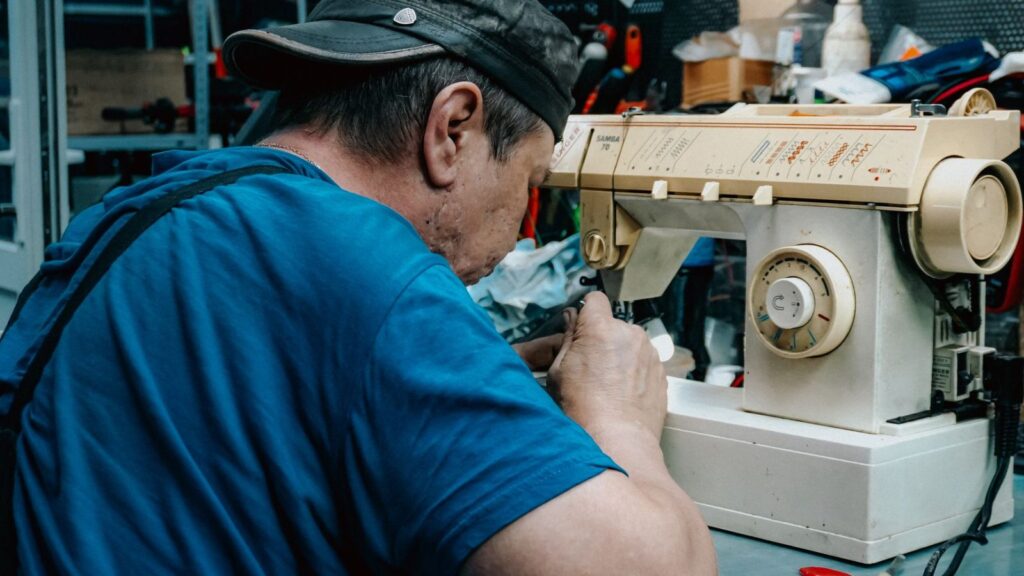
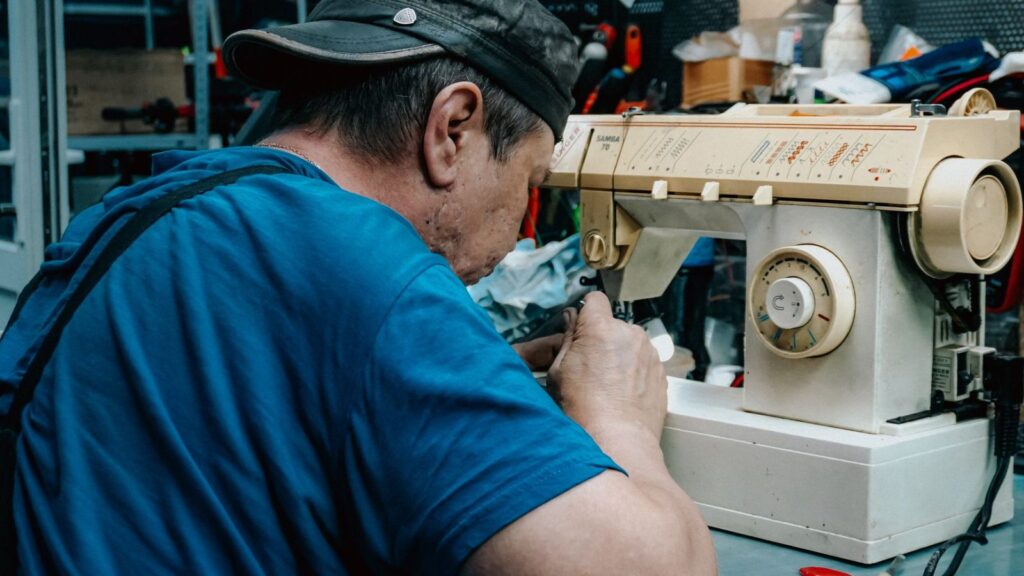
These are the symptoms that most often come into the service centre. For each one you will find the likely causes, what you can check yourself and what we do.
01from 15 €
The sewing machine skips stitches
WhyMost often the culprits are a bent or wrong-type needle, a hook that is out of adjustment, or an incorrectly set distance between the hook and the needle. Knitwear and stretch fabrics need a suitable needle, otherwise stitches get “dropped”.
Check it yourselfUnplug the machine and replace the needle with a new one of the right type and thickness. Make sure the needle is inserted all the way and facing the correct way.
What we doWe check the synchronisation of the needle and hook, adjust the gap between them, and clean and lubricate the mechanism.
02from 15 €
The upper thread keeps breaking
WhyThe cause may be excessive tension, incorrect threading, a scratched spot on the thread guide, or the quality of the thread itself. Old, dried-out thread breaks even more often.
Check it yourselfRe-thread the machine with the presser foot raised and try a different spool. If that does not help, see adjusting the seam tension.
What we doWe check the tension mechanism, the thread path and the needle plate, remove sharp spots and adjust the machine.
03from 15 €
A knot of thread builds up under the fabric
WhyThis is a classic sign that the upper thread did not get between the tension discs because it was threaded with the presser foot lowered. Another cause is a wrongly inserted spool or upper and lower threads of different thickness.
Check it yourselfCut the tangled thread without tearing the fabric. Remove the spool, clean lint from the hook area and re-thread everything following the instructions.
What we doWe take apart the hook area, remove jammed threads, check that the hook or needle plate is not damaged, and make adjustments.
04from 15 €
The needles keep breaking
WhyThe needle breaks when it is too thin for the fabric, when the fabric is pulled by hand, or when the needle touches the hook or presser foot. In the latter case the culprit is a shifted mechanism, not your sewing skills.
Check it yourselfUse the right needle: a thicker one for denim, a ballpoint one for knitwear. Do not push or pull the fabric; let the machine move it along.
What we doWe check the position of the needle bar, the hook gap and the alignment of the presser foot, and restore the geometry.
05from 15 €
The sewing machine does not feed the fabric
WhyMost often the feed dogs are clogged, the feed is set to the lowered mode, or the presser foot pressure is wrong. Sometimes the feed dogs are simply worn or set too low.
Check it yourselfWith the machine switched off, clean the feed dogs with a brush and check that the feed-drop setting is not on. Make sure the presser foot is lowered.
What we doWe clean and adjust the feed dog height and travel, and replace worn parts if necessary.
06from 20 €
The machine does not work or does not respond to the pedal
WhyThis may be a damaged pedal cord or plug, a worn pedal rheostat, or a faulty motor or electronic board. The mechanism may also be jammed, especially if the machine has been standing unused for a long time.
Check it yourselfCheck that the plug is firmly inserted into the socket and that the cord is not kinked or broken. Do not open the housing or repair the electrical part yourself.
What we doWe diagnose whether the problem is in the pedal, the motor or the board, and repair or replace the faulty assembly.
07from 15 €
The machine turns with difficulty, is noisy or rattles
WhyA common cause is hardened old lubricant and dust, worn bearings or a stretched belt. A machine that has not been used for too long often „seizes up” and moves with difficulty.
Check it yourselfBrush away visible dust and lint with a small brush. See how to lubricate a sewing machine mechanism, but do not use universal aerosols.
What we doWe remove the old lubricant, apply suitable lubricants, check the bearings and the belt, and replace worn ones.
08from 20 €
The sewing machine overheats or smells of burning
WhyThe smell may indicate an overworked motor, hardened lubricant or a loose electrical contact. This is not a problem to put off.
Check it yourselfSwitch the machine off immediately and unplug it. Do not turn it on again until it has been inspected.
What we doWe check the motor, wiring and pedal, determine the cause of the overheating and replace the damaged part.
09from 20 €
The computerised machine shows an error or does not respond to the buttons
WhyThe control board, the button membrane or a sensor may be faulty, or there may be a poor contact. Sometimes this is caused by voltage surges or liquid that has got into the housing.
Check it yourselfSwitch the machine off, wait a few minutes and switch it on again. If the error repeats, note down its code or text.
What we doWe diagnose the board and sensors, repair the contacts or replace the faulty part.
10from 15 €
The overlocker does not cut or does not sew neatly
WhyOverlockers have many threads and moving parts, so the most common culprits are incorrect threading, dull blades or a worn looper. Thread tension is adjusted separately for each thread.
Check it yourselfRethread all the threads exactly according to the diagram, and brush away the lint around the blades with the machine switched off.
What we doWe check the blades, loopers and needles, and adjust the mechanism and tension.