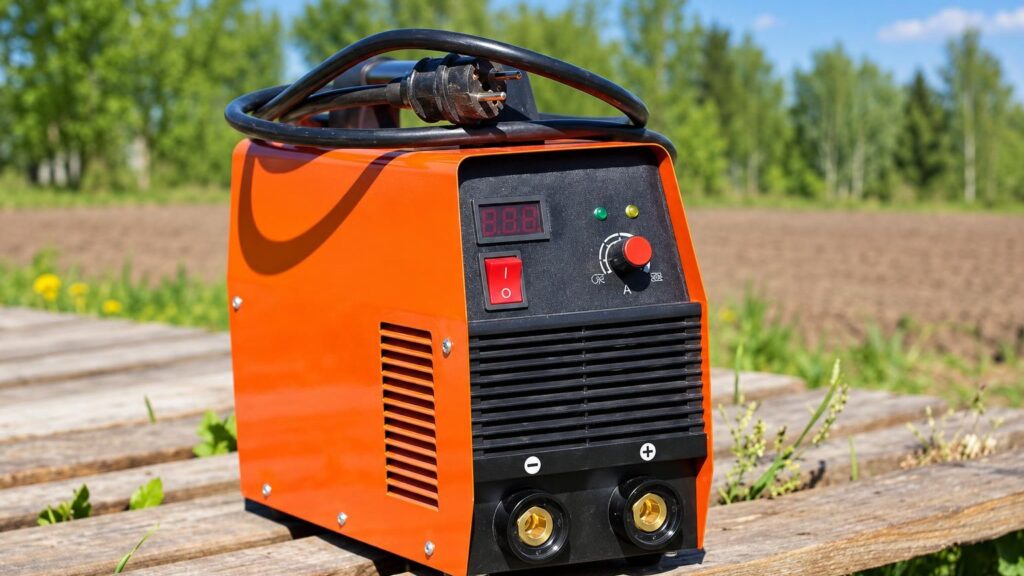
Below are the most common symptoms with which people bring in welding machines. For each, we state what is most often at fault, what you can safely check yourself and what the technician does. Do not open the casing: voltage remains in the inverter capacitors even after the machine is switched off.
01
The welding machine does not work, the indicator does not light up
WhyMost often the power cord or plug is damaged, a fuse has blown, or the input rectifier section has failed. After a power surge or a storm, the input filter may also be damaged.
Check it yourselfTry another socket that definitely works, without an extension cord, and inspect the power cord and plug: cracks, burn marks, loose contacts. Do not open the machine.
What we doWe measure the power supply circuit, check the rectifier, capacitors and fuses, and replace the faulty parts.
02from 15 €
The machine switches on, but does not weld, there is no arc
WhyOften the earth cable, a poor clamp contact or a damaged electrode holder cable is at fault. If the connections are fine, the power transistors or the output rectifier may have failed.
Check it yourselfWith the machine unplugged from the mains, check that the earth clamp is pressed against clean metal, that the holder connector is screwed fully into the socket and that the cables are undamaged.
What we doIf the cable or connector is at fault, we replace it. If not, we measure the power section and replace faulty transistors or diodes.
03
Unstable welding arc, a lot of spatter
WhyMost often the current is wrong, the electrodes are damp or the earth contact is poor. If the settings are correct, the capacitors may have worn out or the control board may be malfunctioning.
Check it yourselfCompare the electrode diameter with the current, dry the electrodes according to the manufacturer’s instructions, and clean the earth contact with the machine unplugged from the mains. For advice on choosing electrodes, read the article how to choose electrodes.
What we doWe measure the output voltage under load and check the control board, capacitors and feedback components.
04
The electrode sticks, the machine lacks power
WhyThe current is too low, the mains voltage has dropped, the extension cord is too long or too thin, or there is an oxide layer on the workpiece. If none of these applies, the power unit may be faulty.
Check it yourselfPlug straight into the socket without an extension cord, clean the metal until it shines and increase the current slightly.
What we doWe measure the input and output parameters, look for the faulty power unit and repair it.
05
The machine overheats and switches off
WhyThe duty cycle has been exceeded, the ventilation openings are clogged with dust, the fan is not turning, or the thermal paste on the power components’ heatsink has dried out.
Check it yourselfUnplug the machine from the mains and let it cool down. Check that the ventilation openings are not blocked and that nothing has been placed on the casing. Do not open the casing.
What we doWe clean the interior, replace the fan, renew the thermal paste and check the temperature sensor.
06
MIG/MAG: the wire jams or is fed unevenly
WhyWorn feed rollers, a clogged wire liner, incorrectly set pressure or a weakening feed motor.
Check it yourselfWith the machine unplugged from the mains, check that the roller groove matches the wire diameter and that the contact tip has not become widened.
What we doWe disassemble the feed mechanism, replace the rollers or motor, and clean the guide liner.
07
The torch gets hot, the cable sparks
WhyPoor contact in the torch connector, a worn tip or damaged cable insulation. In liquid-cooled torches, the cooling system may also be at fault.
Check it yourselfIf you smell burning insulation or see sparking, stop using the torch. With the machine unplugged from the mains, inspect the connector: look for blackening or melted areas.
What we doWe repair or replace the torch cable and connector and check the cooling circuit.
08
MIG or TIG does not supply gas
WhyMost often it is a leak in the hose or connector, a faulty solenoid gas valve, or the pressure regulator. Sometimes the cause is the simplest one – an empty cylinder.
Check it yourselfWith the machine switched off, check that the cylinder is not empty, that the hose clamps are tight and that the hose is not cracked. A leak can be found with soapy water; do not spray water on the machine itself.
What we doWe check the gas valve and hoses, replace damaged parts and check the valve control from the board.
09
The machine gives electric shocks or there is a smell of burning
WhyDamaged insulation, moisture that has got inside, or a broken-down rectifier or capacitor. This is a safety issue, not just a fault.
Check it yourselfUnplug it from the mains immediately and stop using it. Do not open the housing and do not try to dry the machine.
What we doWe measure the insulation, look for the breakdown point and replace damaged parts.
10
The digital display shows an error or the controls do not respond
WhyMost often the control board is faulty, the potentiometer or buttons are worn, and sometimes it is the temperature or current sensor.
Check it yourselfWrite down the error code, unplug the machine from the mains for a few minutes and switch it on again. If the error keeps recurring, bring the machine in.
What we doWe diagnose the control board, repair its circuits and replace controls or sensors.